
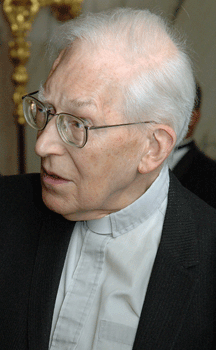
James I. Packer
Introductory Essay to John Owen’s Death of Death in the Death of Christ
I.
The Death of Death in the Death of Christ is a polemical work, designed to show, among other things, that the doctrine of universal redemption is unscriptural and destructive of the gospel. There are many, therefore, to whom it is not likely to be of interest. Those who see no need for doctrinal exactness and have no time for theological debates which show up divisions between so-called Evangelicals may well regret its reappearance. Some may find the very sound of Owen’s thesis so shocking that they will refuse to read his book at all; so passionate a thing is prejudice, and so proud are we of our theological shibboleths. But it is hoped that this reprint will find itself readers of a different spirit. There are signs today of a new upsurge of interest in the theology of the Bible: a new readiness to test traditions, to search the Scriptures and to think through the faith. It is to those who share this readiness that Owen’s treatise is offered, in the belief that it will help us in one of the most urgent tasks facing Evangelical Christendom today—the recovery of the gospel.
This last remark may cause some raising of eyebrows, but it seems to be warranted by the facts.
There is no doubt that Evangelicalism today is in a state of perplexity and unsettlement. In such matters as the practice of evangelism, the teaching of holiness, the building up of local church life, the pastor’s dealing with souls and the exercise of discipline, there is evidence of widespread dissatisfaction with things as they are and of equally widespread uncertainty as to the road ahead. This is a complex phenomenon, to which many factors have contributed; but, if we go to the root of the matter, we shall find that these perplexities are all ultimately due to our having lost our grip on the biblical gospel. Without realising it, we have during the past century bartered that gospel for a substitute product which, though it looks similar enough in points of detail, is as a whole a decidedly different thing. Hence our troubles; for the substitute product does not answer the ends for which the authentic gospel has in past days proved itself so mighty. The new gospel conspicuously fails to produce deep reverence, deep repentance, deep humility, a spirit of worship, a concern for the church. Why? We would suggest that the reason lies in its own character and content. It fails to make men God-centred in their thoughts and God-fearing in their hearts because this is not primarily what it is trying to do. One way of stating the difference between it and the old gospel is to say that it is too exclusively concerned to be “helpful” to man—to bring peace, comfort, happiness, satisfaction—and too little concerned to glorify God. The old gospel was “helpful,” too—more so, indeed, than is the new—but (so to speak) incidentally, for its first concern was always to give glory to God. It was always and essentially a proclamation of Divine sovereignty in mercy and judgment, a summons to bow down and worship the mighty Lord on whom man depends for all good, both in nature and in grace. Its centre of reference was unambiguously God. But in the new gospel the centre of reference is man. This is just to say that the old gospel was religious in a way that the new gospel is not. Whereas the chief aim of the old was to teach men to worship God, the concern of the new seems limited to making them feel better. The subject of the old gospel was God and His ways with men; the subject of the new is man and the help God gives him. There is a world of difference. The whole perspective and emphasis of gospel preaching has changed.
From this change of interest has sprung a change of content, for the new gospel has in effect reformulated the biblical message in the supposed interests of “helpfulness.” Accordingly, the themes of man’s natural inability to believe, of God’s free election being the ultimate cause of salvation, and of Christ dying specifically for His sheep, are not preached. These doctrines, it would be said, are not “helpful”; they would drive sinners to despair, by suggesting to them that it is not in their own power to be saved through Christ. (The possibility that such despair might be salutary is not considered; it is taken for granted that it cannot be, because it is so shattering to our self-esteem.) However this may be (and we shall say more about it later), the result of these omissions is that part of the biblical gospel is now preached as if it were the whole of that gospel; and a half-truth masquerading as the whole truth becomes a complete untruth. Thus, we appeal to men as if they all had the ability to receive Christ at any time; we speak of His redeeming work as if He had done no more by dying than make it possible for us to save ourselves by believing; we speak of God’s love as if it were no more than a general willingness to receive any who will turn and trust; and we depict the Father and the Son, not as sovereignly active in drawing sinners to themselves, but as waiting in quiet impotence “at the door of our hearts” for us to let them in. It is undeniable that this is how we preach; perhaps this is what we really believe. But it needs to be said with emphasis that this set of twisted half-truths is something other than the biblical gospel. The Bible is against us when we preach in this way; and the fact that such preaching has become almost standard practice among us only shows how urgent it is that we should review this matter. To recover the old, authentic, biblical gospel, and to bring our preaching and practice back into line with it, is perhaps our most pressing present need. And it is at this point that Owen’s treatise on redemption can give us help.
II.
"But wait a minute,” says someone, “it’s all very well to talk like this about the gospel; but surely what Owen is doing is defending limited atonement—one of the five points of Calvinism? When you speak of recovering the gospel, don’t you mean that you just want us all to become Calvinists?”
These questions are worth considering, for they will no doubt occur to many. At the same time, however, they are questions that reflect a great deal of prejudice and ignorance. “Defending limited atonement”—as if this was all that a Reformed theologian expounding the heart of the gospel could ever really want to do! “You just want us all to become Calvinists”—as if Reformed theologians had no interest beyond recruiting for their party, and as if becoming a Calvinist was the last stage of theological depravity, and had nothing to do with the gospel at all. Before we answer these questions directly, we must try to remove the prejudices which underlie them by making clear what Calvinism really is; and therefore we would ask the reader to take note of the following facts, historical and theological, about Calvinism in general and the “five points” in particular.
First, it should be observed that the “five points of Calvinism,” so-called, are simply the Calvinistic answer to a five-point manifesto (the Remonstrance) put out by certain “Belgic semi-Pelagians” in the early seventeenth century. The theology which it contained (known to history as Arminianism) stemmed from two philosophical principles: first, that divine sovereignty is not compatible with human freedom, nor therefore with human responsibility; second, that ability limits obligation. (The charge of semi-Pelagianism was thus fully justified.) From these principles, the Arminians drew two deductions: first that since the Bible regards faith as a free and responsible human act, it cannot be caused by God, but is exercised independently of Him; second, that since the Bible regards faith as obligatory on the part of all who hear the gospel, ability to believe must be universal. Hence, they maintained, Scripture must be interpreted as teaching the following positions: (1.) Man is never so completely corrupted by sin that he cannot savingly believe the gospel when it is put before him, nor (2.) is he ever so completely controlled by God that he cannot reject it. (3.) God’s election of those who shall be saved is prompted by His foreseeing that they will of their own accord believe. (4.) Christ’s death did not ensure the salvation of anyone, for it did not secure the gift of faith to anyone (there is no such gift); what it did was rather to create a possibility of salvation for everyone if they believe. (5.) It rests with believers to keep themselves in a state of grace by keeping up their faith; those who fail here fall away and are lost. Thus, Arminianism made man’s salvation depend ultimately on man himself, saving faith being viewed throughout as man’s own work and, because his own, not God’s in him.
The Synod of Dort was convened in 1618 to pronounce on this theology, and the “five points of Calvinism” represent its counter-affirmations. They stem from a very different principle—the biblical principle that “salvation is of the Lord”; and they may be summarized thus: (1.) Fallen man in his natural state lacks all power to believe the gospel, just as he lacks all power to believe the law, despite all external inducements that may be extended to him. (2.) God’s election is a free, sovereign, unconditional choice of sinners, as sinners, to be redeemed by Christ, given faith and brought to glory. (3.) The redeeming work of Christ had as its end and goal the salvation of the elect. (4.) The work of the Holy Spirit in bringing men to faith never fails to achieve its object. (5.) Believers are kept in faith and grace by the unconquerable power of God till they come to glory. These five points are conveniently denoted by the mnemonic TULIP: Total depravity, Unconditional election, Limited atonement, Irresistible grace, Preservation of the saints.
Now, here are two coherent interpretations of the biblical gospel, which stand in evident opposition to each other. The difference between them is not primarily one of emphasis, but of content. One proclaims a God who saves; the other speaks of a God Who enables man to save himself. One view presents the three great acts of the Holy Trinity for the recovering of lost mankind—election by the Father, redemption by the Son, calling by the Spirit—as directed towards the same persons, and as securing their salvation infallibly. The other view gives each act a different reference (the objects of redemption being all mankind, of calling, those who hear the gospel, and of election, those hearers who respond), and denies that any man’s salvation is secured by any of them. The two theologies thus conceive the plan of salvation in quite different terms. One makes salvation depend on the work of God, the other on a work of man; one regards faith as part of God’s gift of salvation, the other as man’s own contribution to salvation; one gives all the glory of saving believers to God, the other divides the praise between God, Who, so to speak, built the machinery of salvation, and man, who by believing operated it. Plainly, these differences are important, and the permanent value of the “five points,” as a summary of Calvinism, is that they make clear the points at which, and the extent to which, these two conceptions are at variance.
However. it would not be correct simply to equate Calvinism with the “five points.” Five points of our own will make this clear.
In the first place, Calvinism is something much broader than the “five points” indicate. Calvinism is a whole world-view, stemming from a clear vision of God as the whole world’s Maker and King. Calvinism is the consistent endeavour to acknowledge the Creator as the Lord, working all things after the counsel of His will. Calvinism is a theocentric way of thinking about all life under the direction and control of God’s own Word. Calvinism, in other words, is the theology of the Bible viewed from the perspective of the Bible—the God-centred outlook which sees the Creator as the source, and means, and end, of everything that is, both in nature and in grace. Calvinism is thus theism (belief in God as the ground of all things), religion (dependence on God as the giver of all things), and evangelicalism (trust in God through Christ for all things), all in their purest and most highly developed form. And Calvinism is a unified philosophy of history which sees the whole diversity of processes and events that take place in God’s world as no more, and no less, than the outworking of His great preordained plan for His creatures and His church. The five points assert no more than that God is sovereign in saving the individual, but Calvinism, as such, is concerned with the much broader assertion that He is sovereign everywhere.
Then, in the second place, the “five points” present Calvinistic soteriology in a negative and polemical form, whereas Calvinism in itself is essentially expository, pastoral and constructive. It can define its position in terms of Scripture without any reference to Arminianism, and it does not need to be forever fighting real or imaginary Arminians in order to keep itself alive. Calvinism has no interest in negatives, as such; when Calvinists fight, they fight for positive Evangelical values. The negative cast of the “five points” is misleading chiefly with regard to the third (limited atonement, or particular redemption), which is often read with stress on the adjective and taken as indicating that Calvinists have a special interest in confining the limits of divine mercy. But in fact the purpose of this phraseology, as we shall see, is to safeguard the central affirmation of the gospel—that Christ is a Redeemer who really does redeem. Similarly, the denials of an election that is conditional and of grace that is resistible, are intended to safeguard the positive truth that it is God Who saves. The real negations are those of Arminianism, which denies that election, redemption and calling are saving acts of God. Calvinism negates these negations in order to assert the positive content of the gospel, for the positive purpose of strengthening faith and building up the church.
Thirdly, the very act of setting out Calvinistic soteriology in the form of five distinct points (a number due, as we saw, merely to the fact that there were five Arminian points for the Synod of Dort to answer) tends to obscure the organic character of Calvinistic thought on this subject. For the five points, though separately stated, are really inseparable. They hang together; you cannot reject one without rejecting them all, at least in the sense in which the Synod meant them. For to Calvinism there is really only one point to be made in the field of soteriology: the point that God saves sinners. God—the Triune Jehovah, Father, Son and Spirit; three Persons working together in sovereign wisdom, power and love to achieve the salvation of a chosen people, the Father electing, the Son fulfilling the Father’s will by redeeming, the Spirit executing the purpose of Father and Son by renewing. Saves—does everything, first to last, that is involved in bringing man from death in sin to life in glory: plans, achieves and communicates redemption, calls and keeps, justifies, sanctifies, glorifies. Sinners—men as God finds them, guilty, vile, helpless, powerless, unable to lift a finger to do God’s will or better their spiritual lot. God saves sinners—and the force of this confession may not be weakened by disrupting the unity of the work of the Trinity, or by dividing the achievement of salvation between God and man and making the decisive part man’s own, or by soft-pedaling the sinner’s inability so as to allow him to share the praise of his salvation with his Saviour. This is the one point of Calvinistic soteriology which the “five points” are concerned to establish and Arminianism in all its forms to deny: namely, that sinners do not save themselves in any sense at all, but that salvation, first and last, whole and entire, past, present and future, is of the Lord, to whom be glory for ever; amen.
This leads to our fourth remark, which is this: the five-point formula obscures the depth of the difference between Calvinistic and Arminian soteriology. There seems no doubt that it seriously misleads many here. In the formula, the stress falls on the adjectives, and this naturally gives the impression that in regard to the three great saving acts of God the debate concerns the adjectives merely—that both sides agree as to what election, redemption, and the gift of internal grace are, and differ only as to the position of man in relation to them: whether the first is conditional upon faith being foreseen or not; whether the second intends the salvation of every man or not; whether the third always proves invincible or not. But this is a complete misconception. The change of adjective in each case involves changing the meaning of the noun. An election that is conditional, a redemption that is universal, an internal grace that is resistible, is not the same kind of election, redemption, internal grace, as Calvinism asserts. The real issue concerns, not the appropriateness of adjectives, but the definition of nouns. Both sides saw this clearly when the controversy first began, and it is important that we should see it too, for otherwise we cannot discuss the Calvinist-Arminian debate to any purpose at all. It is worth setting out the different definitions side by side.
(i.) God’s act of election was defined by the Arminians as a resolve to receive sonship and glory a duly qualified class of people: believers in Christ. This becomes a resolve to receive individual persons only in virtue of God’s foreseeing the contingent fact that they will of their own accord believe. There is nothing in the decree of election to ensure that the class of believers will ever have any members; God does not determine to make any man believe. But Calvinists define election as a choice of particular undeserving persons to be saved from sin and brought to glory, and to that end to be redeemed by the death of Christ and given faith by the Spirit’s effectual calling. Where the Arminian says: “I owe my election to my faith,” the Calvinist says: “I owe my faith to my election.” Clearly, these two concepts of election are very far apart.
(ii.) Christ’s work of redemption was defined by the Arminians as the removing of an obstacle (the unsatisfied claims of justice) which stood in the way of God’s offering pardon to sinners, as He desired to do, on condition that they believe. Redemption, according to Arminianism, secured for God a right to make this offer, but did not of itself ensure that anyone would ever accept it; for faith, being a work of man’s own, is not a gift that comes to him from Calvary. Christ’s death created an opportunity for the exercise of saving faith, but that is all it did. Calvinists, however, define redemption as Christ’s actual substitutionary endurance of the penalty of sin in the place of certain specified sinners, through which God was reconciled to them, their liability to punishment was for ever destroyed, and a title to eternal life was secured for them. In consequence of this, they now have in God’s sight a right to the gift of faith, as the means of entry into the enjoyment of their inheritance. Calvary, in other words, not merely made possible the salvation of those for whom Christ died; it ensured that they would be brought to faith and their salvation made actual. The Cross saves. Where the Arminian will only say: “I could not have gained my salvation without Calvary,” the Calvinist will say: “Christ gained my salvation for me at Calvary.” The former makes the Cross the sine qua non of salvation, the latter sees it as the actual procuring cause of salvation, and traces the source of every spiritual blessing, faith included, back to the great transaction between God and His Son carried through on Calvary’s hill. Clearly, these two concepts of redemption are quite at variance.
(iii.) The Spirit’s gift of internal grace was defined by the Arminians as “moral suasion,” the bare bestowal of an understanding of God’s truth. This, they granted—indeed, insisted—does not of itself ensure that anyone will ever make the response of faith. But Calvinists define this gift as not merely an enlightening, but also a regenerating work of God in men, “taking away their heart of stone, and giving unto them a heart of flesh; renewing their wills, and by His almighty power determining them to that which is good; and effectually drawing them to Jesus Christ; yet so as they come most freely, being made willing by his grace.” Grace proves irresistible just because it destroys the disposition to resist. Where the Arminian, therefore, will be content to say: “I decided for Christ,” “I made up my mind to be a Christian,” the Calvinist will wish to speak of his conversion in more theological fashion, to make plain whose work it really was:
“Long my
imprisoned spirit lay
Fast bound in sin and nature’s night:
Thine eye diffused a quickening ray;
I woke; the dungeon flamed with light;
My chains fell off: my heart was free:
I rose, went forth, and followed thee.”
Clearly, these two notions of internal grace are sharply opposed to each other.
Now, the Calvinist contends that the Arminian idea of election, redemption and calling as acts of God which do not save cuts at the very heart of their biblical meaning; that to say in the Arminian sense that God elects believers, and Christ died for all men, and the Spirit quickens those who receive the word, is really to say that in the biblical sense God elects nobody, and Christ died for nobody, and the Spirit quickens nobody. The matter at issue in this controversy, therefore, is the meaning to be given to these biblical terms, and to some others which are also soteriologically significant, such as the love of God, the covenant of grace, and the verb “save” itself, with its synonyms. Arminians gloss them all in terms of the principle that salvation does not directly depend on any decree or act of God, but on man’s independent activity in believing. Calvinists maintain that this principle is itself unscriptural and irreligious, and that such glossing demonstrably perverts the sense of Scripture and undermines the gospel at every point where it is practised. This, and nothing less than this, is what the Arminian controversy is about.
There is a fifth way in which the five-point formula is deficient. Its very form (a series of denials of Arminian assertions) lends colour to the impression that Calvinism is a modification of Arminianism; that Arminianism has a certain primacy in order of nature, and developed Calvinism is an offshoot from it. Even when one shows this to be false as a matter of history, the suspicion remains in many minds that it is a true account of the relation of the two views themselves. For it is widely supposed that Arminianism (which, as we now see, corresponds pretty closely to the new gospel of our own day) is the result of reading the Scriptures in a “natural,” unbiased, unsophisticated way, and that Calvinism is an unnatural growth, the product less of the texts themselves than of unhallowed logic working on the texts, wresting their plain sense and upsetting their balance by forcing them into a systematic framework which they do not themselves provide. Whatever may have been true of individual Calvinists, as a generalisation about Calvinism nothing could be further from the truth than this. Certainly, Arminianism is “natural” in one sense, in that it represents a characteristic perversion of biblical teaching by the fallen mind of man, who even in salvation cannot bear to renounce the delusion of being master of his fate and captain of his soul. This perversion appeared before in the Pelagianism and semi-Pelagianism of the Patristic period and the later Scholasticism, and has recurred since the seventeenth century both in Roman theology and, among Protestants, in various types of rationalistic liberalism and modern Evangelical teaching; and no doubt it will always be with us. As long as the fallen human mind is what it is, the Arminian way of thinking will continue to be a natural type of mistake. But it is not natural in any other sense. In fact, it is Calvinism that understands the Scriptures in their natural, one would have thought, inescapable meaning; Calvinism that keeps to what they actually say; Calvinism that insists on taking seriously the biblical assertions that God saves, and that He saves those whom He has chosen to save, and that He saves them by grace without works, so that no man may boast, and that Christ is given to them as a perfect Saviour, and that their whole salvation flows to them from the Cross, and that the work of redeeming them was finished on the Cross. It is Calvinism that gives due honour to the Cross. When the Calvinist sings:
“There is a green hill far
away,
Without a city wall,
Where the dear Lord was crucified,
Who died to save us all;
He died the we might be forgiven,
He died
to make us good;
That we might go at last to Heaven,
Saved by His precious blood.”
—he means it. He will not gloss the italicised statements by saying that God’s saving purpose in the death of His Son was a mere ineffectual wish, depending for its fulfilment on man’s willingness to believe, so that for all God could do Christ might have died and none been saved at all. He insists that the Bible sees the Cross as revealing God’s power to save, not His impotence. Christ did not win a hypothetical salvation for hypothetical believers, a mere possibility of salvation for any who might possibly believe, but a real salvation for His own chosen people. His precious blood really does “save us all”; the intended effects of His self-offering do in fact follow, just because the Cross was what it was. Its saving power does not depend on faith being added to it; its saving power is such that faith flows from it. The Cross secured the full salvation of all for whom Christ died. “God forbid,” therefore, “that I should glory, save in the cross of our Lord Jesus Christ.”
Now the real nature of Calvinistic soteriology becomes plain. It is no artificial oddity, nor a product of over-bold logic. Its central confession, that God saves sinners, that Christ redeemed us by His blood, is the witness both of the Bible and of the believing heart. The Calvinist is the Christian who confesses before men in his theology just what he believes in his heart before God when he prays. He thinks and speaks at all times of the sovereign grace of God in the way that every Christian does when he pleads for the souls of others, or when he obeys the impulse of worship which rises unbidden within him, prompting him to deny himself all praise and to give all the glory of his salvation to his Saviour. Calvinism is the natural theology written on the heart of the new man in Christ, whereas Arminianism is an intellectual sin of infirmity, natural only in the sense in which all such sins are natural, even to the regenerate. Calvinistic thinking is the Christian being himself on the intellectual level; Arminian thinking is the Christian failing to be himself through the weakness of the flesh. Calvinism is what the Christian church has always held and taught when its mind has not been distracted by controversy and false traditions from attending to what Scripture actually says; that is the significance of the Patristic testimonies to the teaching of the “five points,” which can be quoted in abundance. (Owen appends a few on redemption; a much larger collection may be seen in John Gill’s The Cause of God and Truth.) So that really it is most misleading to call this soteriology “Calvinism” at all, for it is not a peculiarity of John Calvin and the divines of Dort, but a part of the revealed truth of God and the catholic Christian faith. “Calvinism” is one of the “odious names” by which down the centuries prejudice has been raised against it. But the thing itself is just the biblical gospel. In the light of these facts, we can now give a direct answer to the questions with which we began.
“Surely all that Owen is doing is defending limited atonement?” Not really. He is doing much more than that. Strictly speaking, the aim of Owen’s book is not defensive at all, but constructive. It is a biblical and theological enquiry; its purpose is simply to make clear what Scripture actually teaches about the central subject of the gospel—the achievement of the Saviour. As its title proclaims, it is “a treatise of the redemption and reconciliation that is in the blood of Christ: with the merit thereof, and the satisfaction wrought thereby.” The question which Owen, like the Dort divines before him, is really concerned to answer is just this: what is the gospel? All agree that it is a proclamation of Christ as Redeemer, but there is a dispute as to the nature and extent of His redeeming work: well, what saith the Scripture? what aim and accomplishment does the Bible assign to the work of Christ? This is what Owen is concerned to elucidate. It is true that he tackles the subject in a directly controversial way, and shapes his book as a polemic against the “spreading persuasion...of a general ransom, to be paid by Christ for all; that he dies to redeem all and every one.” But his work is a systematic expository treatise, not a mere episodic wrangle. Owen treats the controversy as providing the occasion for a full display of the relevant biblical teaching in its own proper order and connection. As in Hooker’s Laws of Ecclesiastical Polity, the polemics themselves are incidental and of secondary interest; their chief value lies in the way that the author uses them to further his own design and carry forward his own argument.
That argument is essentially very simple. Owen sees that the question which has occasioned his writing—the extent of the atonement—involves the further question of its nature, since if it was offered to save some who will finally perish, then it cannot have been a transaction securing the actual salvation of all for whom it was designed. But, says Owen, this is precisely the kind of transaction that the Bible says it was. The first two books of his treatise are a massive demonstration of the fact that according to Scripture the Redeemer’s death actually saves His people, as it was meant to do. The third book consists of a series of sixteen arguments against the hypothesis of universal redemption, all aimed to show, on the one hand, that Scripture speaks of Christ’s redeeming work as effective, which precludes its having been intended for any who perish, and, on the other, that if its intended extent had been universal, then either all will be saved (which Scripture denies, and the advocates of the “general ransom” do not affirm), or else the Father and the Son have failed to do what they set out to do—“which to assert,” says Owen, “seems to us blasphemously injurious to the wisdom, power and perfection of God, as likewise derogatory to the worth and value of the death of Christ.”
Owen’s arguments ring a series of changes on this dilemma. Finally, in the fourth book, Owen shows with great cogency that the three classes of texts alleged to prove that Christ died for persons who will not be saved (those saying that He died for “the world,” for “all,” and those thought to envisage the perishing of those for whom He died), cannot on sound principles of exegesis be held to teach any such thing; and, further, that the theological inferences by which universal redemption is supposed to be established are really quite fallacious. The true evangelical evaluation of the claim that Christ died for every man, even those who perish, comes through at point after point in Owen’s book. So far from magnifying the love and grace of God, this claim dishonours both it and Him, for it reduces God’s love to an impotent wish and turns the whole economy of “saving” grace, so-called (“saving” is really a misnomer on this view), into a monumental divine failure. Also, so far from magnifying the merit and worth of Christ’s death, it cheapens it, for it makes Christ die in vain. Lastly, so far from affording faith additional encouragement, it destroys the Scriptural ground of assurance altogether, for it denies that the knowledge that Christ died for me (or did or does anything else for me) is a sufficient ground for inferring my eternal salvation; my salvation, on this view, depends not on what Christ did for me, but on what I subsequently do for myself. Thus this view takes from God’s love and Christ’s redemption the glory that Scripture gives them, and introduces the anti-scriptural principle of self-salvation at the point where the Bible explicitly says: “not of works, lest any man should boast.” You cannot have it both ways: an atonement of universal extent is a depreciated atonement. It has lost its saving power; it leaves us to save ourselves. The doctrine of the general ransom must accordingly be rejected, as Owen rejects it, as a grievous mistake. By contrast, however, the doctrine which Owen sets out, as he himself shows, is both biblical and God-honouring. It exalts Christ, for it teaches Christians to glory in His Cross alone, and to draw their hope and assurance only from the death and intercession of their Saviour. It is, in other words, genuinely Evangelical. It is, indeed, the gospel of God and the catholic faith.
It is safe to say that no comparable exposition of the work of redemption as planned and executed by the Triune Jehovah has ever been done since Owen published his. None has been needed. Discussing this work, Andrew Thomson notes how Owen “makes you feel when he has reached the end of his subject, that he has also exhausted it.” That is demonstrably the case here. His interpretation of the texts is sure; his power of theological construction is superb; nothing that needs discussing is omitted, and (so far as the writer can discover) no arguments for or against his position have been used since his day which he has not himself noted and dealt with. One searches his book in vain for the leaps and flights of logic by which Reformed theologians are supposed to establish their positions; all that one finds is solid, painstaking exegesis and a careful following through of biblical ways of thinking. Owen’s work is a constructive, broad-based biblical analysis of the heart of the gospel, and must be taken seriously as such. It may not be written off as a piece of special pleading for a traditional shibboleth, for nobody has a right to dismiss the doctrine of the limitedness of atonement as a monstrosity of Calvinistic logic until he has refuted Owen’s proof that it is part of the uniform biblical presentation of redemption, clearly taught in plain text after plain text. And nobody has done that yet.
“You talked about recovering the gospel,” said our questioner; “don’t you mean that you just want us all to become Calvinists?”
This question presumably concerns, not the word, but the thing. Whether we call ourselves Calvinists hardly matters; what matters is that we should understand the gospel biblically. But that, we think, does in fact mean understanding it as historic Calvinism does. The alternative is to misunderstand and distort it. We said earlier that modern Evangelicalism, by and large, has ceased to preach the gospel in the old way, and we frankly admit that the new gospel, insofar as it deviates from the old, seems to us a distortion of the biblical message. And we can now see what has gone wrong. Our theological currency has been debased. Our minds have been conditioned to think of the Cross as a redemption which does less than redeem, and of Christ as a Saviour who does less than save, and of God’s love as a weak affection which cannot keep anyone from hell without help, and of faith as the human help which God needs for this purpose. As a result, we are no longer free either to believe the biblical gospel or to preach it. We cannot believe it, because our thoughts are caught in the toils of synergism. We are haunted by the Arminian idea that if faith and unbelief are to be responsible acts, they must be independent acts; hence we are not free to believe that we are saved entirely by divine grace through a faith which is itself God’s gift and flows to us from Calvary. Instead, we involve ourselves in a bewildering kind of double-think about salvation, telling ourselves one moment that it all depends on God and next moment that it all depends on us. The resultant mental muddle deprives God of much of the glory that we should give Him as author and finisher of salvation, and ourselves of much of the comfort we might draw from knowing that God is for us.
And when we come to preach the gospel, our false preconceptions make us say just the opposite of what we intend. We want (rightly) to proclaim Christ as Saviour; yet we end up saying that Christ, having made salvation possible, has left us to become our own saviours. It comes about in this way. We want to magnify the saving grace of God and the saving power of Christ. So we declare that God’s redeeming love extends to every man, and that Christ has died to save every man, and we proclaim that the glory of divine mercy is to be measured by these facts. And then, in order to avoid universalism, we have to depreciate all that we were previously extolling, and to explain that, after all, nothing that God and Christ have done can save us unless we add something to it; the decisive factor which actually saves us is our own believing. What we say comes to this—that Christ saves us with our help; and what that means, when one thinks it out, is this—that we save ourselves with Christ’s help. This is a hollow anticlimax. But if we start by affirming that God has a saving love for all, and Christ died a saving death for all, and yet balk at becoming universalists, there is nothing else that we can say. And let us be clear on what we have done when we have put the matter in this fashion. We have not exalted grace and the Cross; we have cheapened them. We have limited the atonement far more drastically than Calvinism does, for whereas Calvinism asserts that Christ’s death, as such, saves all whom it was meant to save, we have denied that Christ’s death, as such, is sufficient to save any of them. We have flattered impenitent sinners by assuring them that it is in their power to repent and believe, though God cannot make them do it. Perhaps we have also trivialised faith and repentance in order to make this assurance plausible (“it’s very simple—just open your heart to the Lord...”). Certainly, we have effectively denied God’s sovereignty, and undermined the basic conviction of religion—that man is always in God’s hands. In truth, we have lost a great deal. And it is, perhaps, no wonder that our preaching begets so little reverence and humility, and that our professed converts are so self-confident and so deficient in self-knowledge, and in the good works which Scripture regards as the fruit of true repentance.
It is from degenerate faith and preaching of this kind that Owen’s book could set us free. If we listen to him, he will teach us both how to believe the Scripture gospel and how to preach it. For the first: he will lead us to bow down before a sovereign Saviour Who really saves, and to praise Him for a redeeming death which made it certain that all for whom He died will come to glory. It cannot be over-emphasised that we have not seen the full meaning of the Cross till we have seen it as the divines of Dort display it—as the centre of the gospel, flanked on the one hand by total inability and unconditional election, and on the other by irresistible grace and final preservation. For the full meaning of the Cross only appears when the atonement is defined in terms of these four truths. Christ died to save a certain company of helpless sinners upon whom God had set His free saving love. Christ’s death ensured the calling and keeping—the present and final salvation—of all whose sins He bore. That is what Calvary meant, and means. The Cross saved; the Cross saves. This is the heart of true Evangelical faith; as Cowper sang—
“Dear dying
Lamb, Thy precious blood
Shall never lose its power,
Till all the ransomed church of God
Be saved to sin no more.”
This is the triumphant conviction which underlay the old gospel, as it does the whole New Testament. And this is what Owen will teach us unequivocally to believe.
Then, secondly, Owen could set us free, if we would hear him, to preach the biblical gospel. This assertion may sound paradoxical, for it is often imagined that those who will not preach that Christ died to save every man are left with no gospel at all. On the contrary, however, what they are left with is just the gospel of the New Testament. What does it mean to preach “the gospel of the grace of God”? Owen only touches on this briefly and incidentally, but his comments are full of light. Preaching the gospel, he tells us, is not a matter of telling the congregation that God has set His love on each of them and Christ has died to save each of them, for these assertions, biblically understood, would imply that they will all infallibly be saved, and this cannot be known to be true. The knowledge of being the object of God’s eternal love and Christ’s redeeming death belongs to the individual’s assurance, which in the nature of the case cannot precede faith’s saving exercise; it is to be inferred from the fact that one has believed, not proposed as a reason why one should believe. According to Scripture, preaching the gospel is entirely a matter of proclaiming to men, as truth from God which all are bound to believe and act on, the following four facts:
(1.) that all men are sinners, and cannot do anything to save themselves;
(2.) that Jesus Christ, God’s Son, is a perfect Saviour for sinners, even the worst;
(3.) that the Father and the Son have promised that all who know themselves to be sinners and put faith in Christ as Saviour shall be received into favour, and none cast out (which promise is “a certain infallible truth, grounded upon the superabundant sufficiency of the oblation of Christ in itself, for whomsoever [few or more] it be intended”);
(4.) that God has made repentance and faith a duty, requiring of every man who hears the gospel “a serious full recumbency and rolling of the soul upon Christ in the promise of the gospel, as an all-sufficient Saviour, able to deliver and save to the utmost them that come to God by him; ready, able and willing, through the preciousness of his blood and sufficiency of his ransom, to save every soul that shall freely give up themselves unto him for that end.”
The preacher’s task, in other words, is to display Christ: to explain man’s need of Him, His sufficiency to save, and His offer of Himself in the promises as Saviour to all who truly turn to Him; and to show as fully and plainly as he can how these truths apply to the congregation before him. It is not for him to say, nor for his hearers to ask, for whom Christ died in particular. “There is none called on by the gospel once to enquire after the purpose and intention of God concerning the particular object of the death of Christ, every one being fully assured that his death shall be profitable to them that believe in him and obey him.” After saving faith has been exercised, “it lies on a believer to assure his soul, according as he find the fruit of the death of Christ in him and towards him, of the good-will and eternal love of God to him in sending his Son to die for him in particular”; but not before. The task to which the gospel calls him is simply to exercise faith, which he is both warranted and obliged to do by God’s command and promise.
Some comments on this conception of what preaching the gospel means are in order.
First, we should observe that the old gospel of Owen contains no less full and free an offer of salvation than its modern counterpart. It presents ample grounds of faith (the sufficiency of Christ, and the promise of God), and cogent motives to faith (the sinner’s need, and the Creator’s command, which is also the Redeemer’s invitation). The new gospel gains nothing here by asserting universal redemption. The old gospel, certainly, has no room for the cheap sentimentalising which turns God’s free mercy to sinners into a constitutional soft-heartedness on His part which we can take for granted; nor will it countenance the degrading presentation of Christ as the baffled Saviour, balked in what He hoped to do by human unbelief; nor will it indulge in maudlin appeals to the unconverted to let Christ save them out of pity for His disappointment. The pitiable Saviour and the pathetic God of modern pulpits are unknown to the old gospel. The old gospel tells men that they need God, but not that God needs them (a modern falsehood); it does not exhort them to pity Christ, but announces that Christ has pitied them, though pity was the last thing they deserved. It never loses sight of the Divine majesty and sovereign power of the Christ whom it proclaims, but rejects flatly all representations of Him which would obscure His free omnipotence. Does this mean, however, that the preacher of the old gospel is inhibited or confined in offering Christ to men and inviting them to receive Him? Not at all. In actual fact, just because he recognises that Divine mercy is sovereign and free, he is in a position to make far more of the offer of Christ in his preaching than is the expositor of the new gospel; for this offer is itself a far more wonderful thing on his principles than it can ever be in the eyes of those who regard love to all sinners as a necessity of God’s nature, and therefore a matter of course. To think that the holy Creator, who never needed man for His happiness and might justly have banished our fallen race for ever without mercy, should actually have chosen to redeem some of them! and that His own Son was willing to undergo death and descend into hell to save them! and that now from His throne He should speak to ungodly men as He does in the words of the gospel, urging upon them the command to repent and believe in the form of a compassionate invitation to pity themselves and choose life! These thoughts are the focal points round which the preaching of the old gospel revolves. It is all wonderful, just because none of it can be taken for granted. But perhaps the most wonderful thing of all—the holiest spot in all the holy ground of gospel truth—is the free invitation which “the Lord Christ” (as Owen loves to call Him) issues repeatedly to guilty sinners to come to Him and find rest for their souls. It is the glory of these invitations that it is an omnipotent King who gives them, just as it is a chief part of the glory of the enthroned Christ that He condescends still to utter them. And it is the glory of the gospel ministry that the preacher goes to men as Christ’s ambassador, charged to deliver the King’s invitation personally to every sinner present and to summon them all to turn and live. Owen himself enlarges on this in a passage addressed to the unconverted.
“Consider the infinite condescension and love of Christ, in his invitations and calls of you to come unto him for life, deliverance, mercy, grace, peace and eternal salvation. Multitudes of these invitations and calls are recorded in the Scripture, and they are all of them filled up with those blessed encouragements which divine wisdom knows to be suited unto lost, convinced sinners.... In the declaration and preaching of them, Jesus Christ yet stands before sinners, calling, inviting, encouraging them to come unto him.
“This is somewhat of the word which he now speaks unto you: Why will ye die? why will ye perish? why will ye not have compassion on your own souls? Can your hearts endure, or can your hands be strong, in the day of wrath that is approaching?... Look unto me, and be saved; come unto me, and I will ease you of all sins, sorrows, fears, burdens, and give rest unto your souls. Come, I entreat you; lay aside all procrastinations, all delays; put me off no more; eternity lies at the door...do not so hate me as that you will rather perish than accept of deliverance by me.
“These and the like things doth the Lord Christ continually declare, proclaim, plead and urge upon the souls of sinners.... He doth it in the preaching of the word, as if he were present with you, stood amongst you, and spake personally to every one of you.... He hath appointed the ministers of the gospel to appear before you, and to deal with you in his stead, avowing as his own the invitations which are given you in his name, 2 Cor. v. 19, 20.”
These invitations are universal; Christ addresses them to sinners, as such, and every man, as he believes God to be true, is bound to treat them as God’s words to him personally and to accept the universal assurance which accompanies them, that all who come to Christ will be received. Again, these invitations are real; Christ genuinely offers Himself to all who hear the gospel, and is in truth a perfect Saviour to all who trust Him. The question of the extent of the atonement does not arise in evangelistic preaching; the message to be delivered is simply this—that Christ Jesus, the sovereign Lord, who died for sinners, now invites sinners freely to Himself. God commands all to repent and believe; Christ promises life and peace to all who do so. Furthermore, these invitations are marvellously gracious; men despise and reject them, and are never in any case worthy of them, and yet Christ still issues them. He need not, but He does. “Come unto me...and I will give you rest” remains His word to the world, never cancelled, always to be preached. He whose death has ensured the salvation of all His people is to be proclaimed everywhere as a perfect Saviour, and all men invited and urged to believe on Him, whoever they are, whatever they have been. Upon these three insights the evangelism of the old gospel is based.
It is a very ill-informed supposition that evangelistic preaching which proceeds on these principles must be anaemic and half-hearted by comparison with what Arminians can do. Those who study the printed sermons of worthy expositors of the old gospel, such as Bunyan (whose preaching Owen himself much admired), or Whitefield, or Spurgeon, will find that in fact they hold forth the Saviour and summon sinners to Him with a fulness, warmth, intensity and moving force unmatched in Protestant pulpit literature. And it will be found on analysis that the very thing which gave their preaching its unique power to overwhelm their audiences with broken-hearted joy at the riches of God’s grace-and still gives it that power, let it be said, even with hard-boiled modern readers—was their insistence on the fact that grace is free. They knew that the dimensions of Divine love are not half understood till one realises that God need not have chosen to save nor given his Son to die; nor need Christ have taken upon him vicarious damnation to redeem men, nor need He invite sinners indiscriminately to Himself as He does; but that all God’s gracious dealings spring entirely from His own free purpose. Knowing this, they stressed it, and it is this stress that sets their evangelistic preaching in a class by itself. Other Evangelicals, possessed of a more superficial and less adequate theology of grace, have laid the main emphasis in their gospel preaching on the sinner’s need of forgiveness, or peace, or power, and of the way to get them by “deciding for Christ.” It is not to be denied that their preaching has done good (for God will use His truth, even when imperfectly held and mixed with error), although this type of evangelism is always open to the criticism of being too man-centred and pietistic; but it has been left (necessarily) to Calvinists and those who, like the Wesleys, fall into Calvinistic ways of thought as soon as they begin a sermon to the unconverted, to preach the gospel in a way which highlights above everything else the free love, willing condescension, patient long-suffering and infinite kindness of the Lord Jesus Christ. And, without doubt, this is the most Scriptural and edifying way to preach it; for gospel invitations to sinners never honour God and exalt Christ more, nor are more powerful to awaken and confirm faith, than when full weight is laid on the free omnipotence of the mercy from which they flow. It looks, indeed, as if the preachers of the old gospel are the only people whose position allows them to do justice to the revelation of Divine goodness in the free offer of Christ to sinners.
Then, in the second place, the old gospel safeguards values which the new gospel loses. We saw before that the new gospel, by asserting universal redemption and a universal Divine saving purpose, compels itself to cheapen grace and the Cross by denying that the Father and the Son are sovereign in salvation; for it assures us that, after God and Christ have done all that they can, or will, it depends finally on each man’s own choice whether God’s purpose to save him is realised or not. This position has two unhappy results. The first is that it compels us to misunderstand the significance of the gracious invitations of Christ in the gospel of which we have been speaking; for we now have to read them, not as expressions of the tender patience of a mighty sovereign, but as the pathetic pleadings of impotent desire; and so the enthroned Lord is suddenly metamorphosed into a weak, futile figure tapping forlornly at the door of the human heart, which He is powerless to open. This is a shameful dishonour to the Christ of the New Testament. The second implication is equally serious: for this view in effect denies our dependence on God when it comes to vital decisions, takes us out of His hand, tells us that we are, after all, what sin taught us to think we were—masters of our fate, captain of our souls—and so undermines the very foundation of man’s religious relationship with his Maker. It can hardly be wondered at that the converts of the new gospel are so often both irreverent and irreligious, for such is the natural tendency of this teaching. The old gospel, however, speaks very differently and has a very different tendency. On the one hand, in expounding man’s need of Christ, it stresses something which the new gospel effectively ignores—that sinners cannot obey the gospel, any more than the law, without renewal of heart. On the other hand, in declaring Christ’s power to save, it proclaims Him as the author and chief agent of conversion, coming by His Spirit as the gospel goes forth to renew men’s hearts and draw them to Himself. Accordingly, in applying the message, the old gospel, while stressing that faith is man’s duty, stresses also that faith is not in man’s power, but that God must give what He commands. It announces, not merely that men must come to Christ for salvation, but also that they cannot come unless Christ Himself draws them. Thus it labours to overthrow self-confidence, to convince sinners that their salvation is altogether out of their hands, and to shut them up to a self-despairing dependence on the glorious grace of a sovereign Saviour, not only for their righteousness but for their faith too.
It is not likely, therefore, that a preacher of the old gospel will be happy to express the application of it in the form of a demand to “decide for Christ,” as the current phrase is. For, on the one hand, this phrase carries the wrong associations. It suggests voting a person into office—an act in which the candidate plays no part beyond offering himself for election, and everything then being settled by the voter’s independent choice. But we do not vote God’s Son into office as our Saviour, nor does He remain passive while preachers campaign on His behalf, whipping up support for His cause. We ought not to think of evangelism as a kind of electioneering. And then, on the other hand, this phrase obscures the very thing that is essential in repentance and faith—the denying of self in a personal approach to Christ. It is not at all obvious that deciding for Christ is the same as coming to Him and resting on Him and turning from sin and self-effort; it sounds like something much less, and is accordingly calculated to instil defective notions of what the gospel really requires of sinners. It is not a very apt phrase from any point of view.
To the question: what must I do to be saved? the old gospel replies: believe on the Lord Jesus Christ. To the further question: what does it mean to believe on the Lord Jesus Christ? its reply is: it means knowing oneself to be a sinner, and Christ to have died for sinners; abandoning all self-righteousness and self-confidence, and casting oneself wholly upon Him for pardon and peace; and exchanging one’s natural enmity and rebellion against God for a spirit of grateful submission to the will of Christ through the renewing of one’s heart by the Holy Ghost. And to the further question still: how am I to go about believing on Christ and repenting, if I have no natural ability to do these things? it answers: look to Christ, speak to Christ, cry to Christ, just as you are; confess your sin, your impenitence, your unbelief, and cast yourself on His mercy; ask Him to give you a new heart, working in you true repentance and firm faith; ask Him to take away your evil heart of unbelief and to write His law within you, that you may never henceforth stray from Him. Turn to Him and trust Him as best you can, and pray for grace to turn and trust more thoroughly; use the means of grace expectantly, looking to Christ to draw near to you as you seek to draw near to Him; watch, pray, read and hear God’s Word, worship and commune with God’s people, and so continue till you know in yourself beyond doubt that you are indeed a changed being, a penitent believer, and the new heart which you desired has been put within you. The emphasis in this advice is on the need to call upon Christ directly, as the very first step.
“Let not
conscience make you linger,
Nor of fitness fondly dream;
All the fitness He requireth
Is to feel your need of Him”
—so do not postpone action till you think you are better, but honestly confess your badness and give yourself up here and now to the Christ who alone can make you better; and wait on Him till His light rises in your soul, as Scripture promises that it shall do. Anything less than this direct dealing with Christ is disobedience of the gospel. Such is the exercise of spirit to which the old evangel summons its hearers. “I believe—help thou mine unbelief”: this must become their cry.
And the old gospel is proclaimed in the sure confidence that the Christ of whom it testifies, the Christ who is the real speaker when the Scriptural invitations to trust Him are expounded and applied, is not passively waiting for man’s decision as the word goes forth, but is omnipotently active, working with and through the word to bring His people to faith in Himself. The preaching of the new gospel is often described as the task of “bringing men to Christ” if only men move, while Christ stands still. But the task of preaching the old gospel could more properly be described as bringing Christ to men, for those who preach it know that as they do their work of setting Christ before men’s eyes, the mighty Saviour whom they proclaim is busy doing His work through their words, visiting sinners with salvation, awakening them to faith, drawing them in mercy to Himself.
It is this older gospel which Owen will teach us to preach: the gospel of the sovereign grace of God in Christ as the author and finisher of faith and salvation. It is the only gospel which can be preached on Owen’s principles, but those who have tasted its sweetness will not in any case be found looking for another. In the matter of believing and preaching the gospel, as in other things, Jeremiah’s words still have their application: “Thus saith the Lord, Stand ye in the ways, and see, and ask for the old paths, where is the good way, and walk therein, and ye shall find rest for your souls.” To find ourselves debarred, as Owen would debar us, from taking up with the fashionable modern substitute gospel may not, after all, be a bad thing, either for us, or for the Church.
More might be said, but to go further would be to exceed the limits of an introductory essay. The foregoing remarks are made simply to show how important it is at the present time that we should attend most carefully to Owen’s analysis of what the Bible says about the saving work of Christ.
III.
It only remains to add a few remarks about this treatise itself. It was Owen’s second major work, and his first masterpiece. (Its predecessor, A Display of Arminianism, published in 1642, when Owen was twenty-six, was a competent piece of prentice-work, rather of the nature of a research thesis.)
The Death of Death is a solid book, made up of detailed exposition and close argument, and requires hard study, as Owen fully realised; a cursory glance will not yield much. (“READER.... If thou art, as many in this pretending age, a sign or title gazer, and comest into books as Cato into the theatre, to go out again—thou has had thy entertainment; farewell!”) Owen felt, however, that he had a right to ask for hard study, for his book was a product of hard work (“a more than seven-years’ serious inquiry...into the mind of God about these things, with a serious perusal of all which I could attain that the wit of man, in former or latter days, hath published in opposition to the truth”), and he was sure in his own mind that a certain finality attached to what he had written. (“Altogether hopeless of success I am not; but fully resolved that I shall not live to see a solid answer given unto it.”) Time has justified his optimism.
Something should be said about his opponents. He is writing against three variations on the theme of universal redemption: that of classical Arminianism, noted earlier; that of the theological faculty at Saumur (the position known as Amyraldism, after its leading exponent); and that of Thomas More, a lay theologian of East Anglia. The second of these views originated with a Scots professor at Saumur, John Cameron; it was taken up and developed by two of his pupils, Amyraut (Amyraldus) and Testard, and became the occasion of a prolonged controversy in which Amyraut, Daillé and Blondel were opposed by Rivet, Spanheim and Des Marets (Maresius). The Saumur position won some support among Reformed divines in Britain, being held in modified form by (among others) Bishops Usher and Davenant, and Richard Baxter. None of these, however, had advocated it in print at the time when Owen wrote.
Goold’s summary of the Saumur position may be quoted. “Admitting that, by the purpose of God, and through the death of Christ, the elect are infallibly secured in the enjoyment of salvation, they contended for an antecedent decree, by which God is free to give salvation to all men through Christ, on the condition that they believe on him. Hence their system was termed hypothetic[al] universalism. The vital difference between it and the strict Arminian theory lies in the absolute security asserted in the former for the spiritual recovery of the elect. They agree, however, in attributing some kind of universality to the atonement, and in maintaining that, on a certain condition, within the reach of fulfilment by all men...all men have access to the benefits of Christ’s death.” From this, Goold continues, “the readers of Owen will understand...why he dwells with peculiar keenness and reiteration of statement upon a refutation of the conditional system.... It was plausible; it had many learned men for its advocates; it had obtained currency in the foreign churches; and it seems to have been embraced by More.”
More is described by Thomas Edwards as “a great Sectary, that did much hurt in Lincolnshire, Norfolk, and Cambridgeshire; who was famous also in Boston, (King’s) Lynn, and even in Holland, and was followed from place to place by many.” Baxter’s description is kinder: “a Weaver of Wisbitch and Lyn, of excellent Parts.” (More’s doctrine of redemption, of course, was substantially Baxter’s own.) Owen, however, has a poor view of his abilities, and makes no secret of the fact. More’s book, The Universality of God’s Free Grace in Christ to Mankind, appeared in 1646 (not, as Goold says, 1643), and must have exercised a considerable influence, for within three years it had evoked four weighty works which were in whole or part polemics against it: A Refutation...of Thomas More, by Thomas Whitfield, 1646; Vindiciae Redemptionis, by John Stalham, 1647; The Universalist Examined and Convicted, by Obadiah Howe, 1648; and Owen’s own book, published in the same year.
More’s exposition seems to be of little intrinsic importance; Owen, however, selects it as the fullest statement of the case for universal redemption that had yet appeared in English and uses it unmercifully as a chopping-block. The modern reader, however, will probably find it convenient to skip the sections devoted to refuting More (I. viii., the closing pages of II. iii. and IV. vi.) on his first passage through Owen’s treatise.
Finally, a word about the style of this work. There is no denying that Owen is heavy and hard to read. This is not so much due to obscure arrangement as to two other factors. The first is his lumbering literary gait. “Owen travels through it (his subject) with the elephant’s grace and solid step, if sometimes also with his ungainly motion.” says Thomson. That puts it kindly. Much of Owen’s prose reads like a roughly-dashed-off translation of a piece of thinking done in Ciceronian Latin. It has, no doubt, a certain clumsy dignity; so has Stonehenge; but it is trying to the reader to have to go over sentences two or three times to see their meaning, and this necessity makes it much harder to follow an argument. The present writer, however, has found that the hard places in Owen usually come out as soon as one reads them aloud. The second obscuring factor is Owen’s austerity as an expositor. He has a lordly disdain for broad introductions which ease the mind gently into a subject, and for comprehensive summaries which gather up scattered points into a small space. He obviously carries the whole of his design in his head, and expects his readers to do the same. Nor are his chapter divisions reliable pointers to the structure of his discourse, for though a change of subject is usually marked by a chapter division, Owen often starts a new chapter where there is no break in the thought at all. Nor is he concerned about literary proportions; the space given to a topic is determined by its intrinsic complexity rather than its relative importance, and the reader is left to work out what is basic and what is secondary by noting how things link together. The reader will probably find it helpful to use a pencil and paper in his study of the book and jot down the progress of the exposition; and it is hoped that the subjoined Analysis will also be of service in helping him keep his bearings.
We would conclude by repeating that the reward to be reaped from studying Owen is worth all the labour involved, and by making the following observations for the student’s guidance. (1.) It is important to start with the epistle “To the Reader,” for there Owen indicates in short compass what he is trying to do, and why. (2.) It is important to read the treatise as a whole, in the order in which it stands, and not to jump into parts III. and IV. before mastering the contents of Parts I. and II., where the biblical foundations of Owen’s whole position are laid. (3.) It is hardly possible to grasp the strength and cogency of this massive statement on a first reading. The work must be read and re-read to be appreciated.

This material has not been discussed yet.