
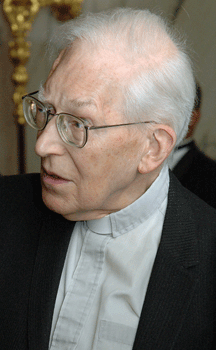
James I. Packer
Puritan Evangelism
In the report of the Archbishop’s Committee on Evangelism, published in 1945 under the title: Towards the Conversion of England, the work of evangelism is conveniently defined as follows: “so to present Christ Jesus in the power of the Holy Spirit, that men shall come to put their trust in God through Him, to accept Him as their Savior, and serve Him as their King in fellowship of His Church.”
Did the Puritans tackle the task of evangelism at all? At first sight, it might seem not. They agreed with Calvin in regarding the “evangelists” mentioned in the New Testament as all order of assistants to the apostles, now extinct; and as for “missions,” “crusades” and “campaigns,” they knew neither the name nor the thing. But we must not be misled into supposing that evangelism was not one of their chief concerns. It was. Many of them were outstandingly successful as preachers to the unconverted. Richard Baxter, the apostle of Kidderminster, is perhaps the only one of these that is widely remembered today; but in contemporary records it is common to read statements like this, of Hugh Clark: “he begat many Sons and Daughters unto God;” or this, of John Cotton, “the presence of the Lord…crowning his labors with the Conversion of many Souls” (S. Clarke, Lives of 52…Divines, pp.131, 222, etc.) Moreover, it was the Puritans who invented evangelistic literature. One has only to think of Baxter’s classic Call to the Unconverted, and Alleine’s Alarm to the Unconverted, which were pioneer works in this class of writing. And the elaborate practical “handling” of the subject of conversion in Puritan books was regarded by the rest of the seventeenth-century Protestant world as something of unique value. “It hath been one of the glories of the Protestant religion that it revived the doctrine of Saving Conversion, and of the New Creature brought forth thereby…But in a more eminent manner, God hath cast the honor hereof upon the Ministers and Preachers of this Nation, who are renowned abroad for their more accurate search into and discoveries hereof.” (T. Goodwin and P. Nye, Preface to T. Hooker, The Application of Redemption, 1656).
The truth is that two distinct conceptions and types of evangelism have been developed in Protestant Christendom during the course of its history. We may call them the “Puritan” type and the “modern” type. Today we are so accustomed to evangelism of the modern type that we scarcely recognize the other is evangelism at all. In order that we may fully grasp the character of the Puritan type of evangelism, I shall here set it in contrast with the modern type, which has so largely superseded it at the present time.
Let us begin, therefore, by characterizing evangelism of the modern type. It seems to presuppose a conception of the life of the local church as an alternating cycle of converting and edifying. Evangelism almost takes on the character of a periodical recruiting campaign. It is all extraordinary and occasional activity, additional and auxiliary to the regular functioning of the local congregation. Special gatherings of a special sort are arranged, and special preachers are commonly secured to conduct them. Often they are called “meetings” rather than “services;” in any case, they are thought of as something distinct in some way from the regular public worship of God. In the meetings, everything is directly aimed at securing from the unconverted all immediate, conscious, decisive act of faith in Christ. At the close of the meeting, those who have responded or wish to do so are asked to come to the front, or raise a hand, or something similar, as an act of public testimony to their new resolutions. This, it is claimed, is good for those who do it, since it helps to make their “decision” definite, and it has the further advantage of making them declare themselves, so that they may be contacted individually by “personal workers.” Such persons may then be advised and drafted forthwith into local churches as converts.
This type of evangelism was invented by Charles G. Finney in the 1820’s. He introduced the “protracted meeting,” or, as we should call it, the intensive evangelistic campaign, and the “anxious seat,” a front pew left vacant where at the end of the meeting “the anxious may come and be addressed particularly…and sometimes be conversed with individually.” At the end of his sermon, he would say, “There is the anxious seat; come out, and avow determination to be on the Lord’s side.” (See Revivals of Religion, especially chapter xiv). These were Finney’s much opposed “new measures.”
Now, Finney was a clear-headed and self-confessed Pelagian in his doctrine of man; and this is the reason why his “new measures” were evolved. Finney denied that fallen man is totally unable to repent, believe or do anything spiritually good without grace, and affirmed instead that all men have plenary ability to turn to God at any time. Man is a rebel, but is perfectly free at any time to lay down his arms in surrender. Accordingly, the whole work of the Spirit of God in conversion is to present vividly to man’s mind reasons for making this surrender - that is to say, the Spirit’s work is confined to moral persuasion. Man is always free to reject this persuasion: “Sinners can go to hell in spite of God.” But the stronger the persuasion is, the more likely it is to succeed in the breaking down of man’s resistance. Every means, therefore, of increasing the force and vividness with which truth impinged on the mind - the most frenzied excitement, the most narrowing emotionalism, the most nerve-racking commotion in evangelistic meetings - was a right and proper means of evangelism. Finney gave expression to this principle in the first of his lectures on Revivals of Religion. “To expect to promote religion without excitements is unphilosophical and absurd…until there is sufficient religious principle in the world to put down irreligious excitements, it is in vain to try to promote religion, except by counteracting excitements…There must be excitement sufficient to wake up the dormant moral powers…” And, since every man, if he will only rouse up his “dormant moral powers,” can at any time yield to God and become a Christian, it is the evangelist’s work and duty always to preach for immediate decision, to tell men that it is their duty to come to Christ that instant, and to use all means – such as the rousing appeal and the “anxious seat” - for persuading them to do so. “I tried to shut them up,” he says of a typical mission sermon, “to present faith and repentance, as the thing which God required of them: present and instant acceptance of His will, present and instant acceptance of Christ” (Autobiography, p. 64). It is hardly too much to say that Finney regarded evangelistic preaching as a battle of wills between himself and his hearers, in which it was his responsibility to bring them to breaking point.
Now, if Finney’s doctrine of the natural state of sinful man is right, then his evangelistic methods must be judged right also, for, as he often insisted, the “new measures” were means well adapted to what he held to be the end in view. “It is in such practices that a Pelagian system naturally expresses itself if it seeks to become aggressively evangelistic” (B. B. Warfield). But if his view of man is wrong, then his methods, as we shall see, must be judged disastrous. And this is an issue of the first importance at the present time; for it is Finney’s methods, modified and adapted, which characterize most evangelism today. We do not suggest that all who use them are Pelagians. But we do raise the question, whether the use of such methods is consistent with any other doctrine than Finney’s, and we shall try to show that, if Finney’s doctrine is rejected, then such methods must be judged inappropriate and, indeed, detrimental to the real work of evangelism. It may be said that results justify their use; but the truth is that the majority of Finney’s “converts” backslid and fell away, and so, it seems, have the majority of those since Finney’s day whose “decision” has been secured by the use of such methods. Most modern evangelists seem to have given up expecting more than a small percentage of their “converts” to survive. It is not at all obvious that results justify such methods. We shall suggest later that they have a natural tendency to produce such a crop of false converts as has in fact resulted from their use.
The Puritan type of evangelism, on the other hand, was the consistent expression in practice of the Puritans’ conviction that the conversion of a sinner is a gracious sovereign work of Divine power. We shall spend a little time elaborating this.
The Puritans did not use “conversion” and “regeneration” as technical terms, and so there are slight variations in usage. Perhaps the majority treated the words as synonyms, each denoting the whole process whereby God brings the sinner to his first act of faith. Their technical term for the process was effectual calling; calling being the Scriptural word used to describe the process in Rom. 8:30, 2 Th. 2:14, 2 Tim. 1:9, etc., and the adjective effectual being added to distinguish it from the ineffectual, external calling mentioned in Mt. 20:16, 22:14. Westminster Confession, X. i., puts “calling,” into its theological perspective by an interpretative paraphrase of Rom. 8:30: “All those whom God hath predestinated unto life, and those only, he is pleased, in his appointed and accepted time, effectually to call, by his Word and Spirit, out of that state of sin and death in which they are by nature, to grace and salvation by Jesus Christ.” The Westminster Shorter Catechism analyses the concept of “calling” in its answer to Q. 31: “Effectual calling is the work of God’s Spirit whereby, convincing us of our sin and misery, enlightening our minds in the knowledge of Christ, and renewing our wills, he doth persuade and enable us to embrace Jesus Christ, freely offered to us in the gospel.”
Concerning this effectual calling, three things must be said if we are to grasp the Puritan view:
(i) It is a work of Divine grace; it is not something a man can do for himself or for another. It is the first stage in the application of redemption to those for whom it was won; it is the time when, on the grounds of his eternal, federal, representative union with Christ, the elect sinner is brought by the Holy Ghost into a real, vital, personal union with his Covenant Head and Redeemer. It is thus a gift of free Divine grace.
(ii) It is a work of Divine power. It is effected by the Holy Ghost, who acts both mediately, by the Word, in the mind, giving understanding and conviction, and at the same time immediately, with the Word, in the hidden depths of the heart, implanting new life and power, effectively dethroning sin, and making the sinner both able and willing to respond to the gospel invitation. The Spirit’s work is thus both moral, by persuasion (which all Arminians and Pelagians would allow), and also physical, by power (which they would not).
Owen said, “There is not only a moral, but a physical immediate operation of the Spirit…upon the minds or souls of men in their regeneration…The work of grace in conversion is constantly expressed by words denoting a real internal efficacy; such as creating, quickening, forming, giving a new heart…Wherever this work is spoken of with respect unto an active efficacy, it is ascribed to God. He creates us anew, he quickens us, he begets us of His own will; but when it is spoken of with respect to us, there it is passively expressed; we are created in Christ Jesus, we are new creatures, we are born again, and the like; which one observation is sufficient to avert the whole hypothesis of Arminian grace.” (Works, ed. Russell 1,1, II. 369). “Ministers knock at the door of men’s hearts (persuasion), the Spirit comes with a key and opens the door” (T. Watson, Body of Div., 1869, p. 154). The Spirit’s regenerating action, Owen goes on, is “infallible, victorious, irresistable, or always efficacious” (loc cit.); it “removeth all obstacles, overcomes all oppositions, and infallibly produceth the effect intended.” Grace is irresistible, not because it drags man to Christ against his will, but because it changes men’s hearts so that they come most freely, being made willing by His grace.” (West. Conf. X. i). The Puritans loved to dwell on the Scriptural thought of the Divine power put forth in effectual calling, which Goodwin regularly described as the one “standing miracle” in the Church. They agreed that in the normal course of events conversion was not commonly a spectacular affair; but Goodwin notes that sometimes it is, and affirms that thereby God shows us how great an exercise of power every man’s effectual calling involves. “In the calling of some there shoots up very suddenly an election-conversion (I use to call it so). You shall, as it were, see election take hold of a man, pull him out with a mighty power, stamp upon him, the divine nature, stub up corrupt nature by the roots, root up self-love, put in a principle of love to God, and launch him forth a new creature the first day ... He did so with Paul, and it is not without example in others after him.” (Works, ed.. Miller IX. 279). Such dramatic conversions, says Goodwin, are “visible tokens of election by such a work of calling, as all the powers in heaven and earth could not have wrought upon a man’s soul so, nor changed a man so on a sudden, but only that divine power that created the world (and) raised Christ from the dead.”
The reason why the Puritans thus magnified the quickening power of God is plain from the passages quoted:it was because they took so seriously the Bible teaching that man is dead in sin, radically depraved, sin’s helpless bondslave. There is, they held, such a strength in sin that only omnipotence can break its bond; and only the Author of Life can raise the dead. Where Finney assumed plenary ability, the Puritans taught total inability in fallen man.
(iii) Effectual calling is and must be a work of Divine sovereignty. Only God can effect it, and He does so at His own pleasure. “It is not of him that willith, nor of him that runneth, but of God that showeth mercy” (Rom. 9:16). Owen expounds this in a sermon on Acts 16:9, “A vision of unchangeable, free mercy in sending the means of grace to undeserving sinners” (XV, I ff.). He first states the following principle: “All events and effects, especially concerning the propagation of the gospel, and the Church of Christ, are in their greatest variety regulated by the eternal purpose and counsel of God,” He then illustrates it. Some are sent the gospel, some not. “In this chapter…the gospel is forbidden to be preached in Asia or Bithynia; which restraint, the Lord by His providence as yet continueth to many parts of the world;” while “to some nations the gospel is sent…as in my text, Macedonia; and England…” Now, asks Owen, why this discrimination? Why do some hear and others not? And when the gospel is heard, why do we see “various effects, some continuing in impenitency, others in sincerity closing with Jesus Christ?…In effectual working of grace…whence do you think it takes its rule and determination . . . that it should be directed to John, not Judas; Simon Peter, not Simon Magus? Why only from this discriminating counsel of God from eternity…Acts 13:48…The purpose of God’s election, is the rule of dispensing saving grace.”
Jonathan Edwards, a great Puritan evangelist, often makes the same point. In a typical passage from a sermon on Rom. 9:18, he lists the following ways in which God’s sovereignty (defined as “His absolute right of disposing of all creatures according to His own pleasure”) appears in the dispensations of grace:” (1) In calling one nation or people, and giving them the means of grace, and leaving others without them. (2) In the advantages He bestows upon particular persons” (e.g. a Christian home, a powerful ministry, direct spiritual influences, etc.); (4) In bestowing salvation on some who have had few advantages” (e.g. children of ungodly parents, while the children of the godly are not always saved); “(5) In calling some to salvation, who have been heinously wicked, and leaving others, who have been very moral and religious persons… (6) In saving some of those who seek salvation and not others (i.e., bringing some convicted sinners to saving faith while others never attain to sincerity) (Works, 1838, II, 849 f.).” This display of sovereignty by God, Edwards maintained, is glorious: “it is part of the glory of God’s mercy that it is sovereign mercy.”
It is probably true that no preacher in the Puritan tradition ever laid such sustained stress on the sovereignty of God as Edwards. It may come as a surprise to modern readers to discover that such preaching as his was evangelistically very fruitful; but such was the case. Revival swept through his church under his ministry, and in the revival (to quote his own testimony) “I think I have found that no discourses have been more remarkably blessed, than those in which the doctrine of God’s absolute sovereignty, with regard to the salvation of sinners, and his just liberty, with regard to answering prayer, and succeeding the pains, of natural men, continuing such, have been insisted on” (I. 353). There is much food for thought here.
God’s sovereignty appears also in the time of conversion. Scripture and experience show that “the great God for holy and glorious ends, but more especially…to make appear His love and kindness, His mercy and grace, hath ordained it so” that many of His elect people “should for some time remain in a condition of sin and wrath, and then He renews them to Himself” (Goodwin, VI, 85). It is never man, but always God, who determines when an elect sinner shall believe. In the manner of conversion too, God is sovereign. The Puritans taught that, as a general rule, conviction of sin, induced by, the preaching of the Law, must precede faith, since no man will or can come to Christ to be saved from sin till he knows what sins he needs saving from. It is a distinctive feature of the Puritan doctrine of conversion that this point, the need for “preparation” for faith, is so stressed. Man’s first step toward conversion must be some knowledge, of God, of himself, of his duty and of his sin. The second step is conviction, both of sinfulness and of particular sins; and the wise minister, dealing with enquirers at this stage, will try to deepen conviction and make it specific, since true and sound conviction of sin is always to a greater or less degree particularised. This leads to contrition (sorrow for and hatred of sin), which begins to burn the love of sinning out of the heart and leads to real, though as yet ineffective, attempts to break off the practice of sin in the life. Meanwhile, the wise minister, seeing that the fallow ground is now ploughed up, urges the sinner to turn to Christ. This is the right advice to give to a man who has shown that with all his heart he desires to be saved from sin; for when a man wants to be saved from sin, then it is possible for him genuinely and sincerely to receive the One who presents Himself to man as the Saviour from sin. But it is not possible otherwise; and therefore the Puritans over and over again beg ministers not to short-circuit the essential preparatory process. They must not give false encouragement to those in whom the Law has not yet done its work. It is the worst advice possible to tell a man to stop worrying about his sins and trust Christ at once if he does not yet know his sins and does not yet desire to leave them. That is the way to encourage false peace and false hopes, and to produce “gospel- hypocrites.” Throughout the whole process of preparation, from the first awakening of concern to the ultimate dawning of faith, however, the sovereignty of God must be recognised. God converts no adult without preparing him; but “God breaketh not all men’s hearts alike” (Baxter). Some conversions, as Goodwin said, are sudden; the preparation is done in a moment. Some are long-drawn-out affairs; years may pass before the seeker finds Christ and peace, as in Bunyan’s case. Sometimes great sinners experience “great meltings” (Giles Firmin) at the outset of the work of grace, while upright persons spend long periods in agonies of guilt and terror. No rule can be given as to how long, or how intensely, God will flay each sinner with the lash of conviction. Thus the work of effectual calling proceeds as fast, or as slow, as God wills; and the minister’s part is that of the midwife, whose task it is to see what is happening and give appropriate help at each stage, but who cannot foretell, let alone fix, how rapid the process of birth will be.
From these principles the Puritans deduced their characteristic conception of the practice of evangelism. Since God enlightens, convicts, humbles and converts through the the Word, the task of His messengers is to communicate that word, preaching and applying law and gospel. Preachers are to declare God’s mind as set forth in the texts they expound, to show the way of salvation, to exhort the unconverted to learn the law, to meditate on the Word, to humble themselves, to pray that God will show them their sins, and enable them to come to Christ. They are to hold Christ forth as a perfect Saviour from sin to all who Heartily desire to be saved from sin, and to invite such (the weary and burdened souls whom Christ Himself invites, Mt. 11:28) to come to the Saviour who waits to receive them. But they are not to do as Finney did, and demand immediate repentance and faith of all and sundry. They are sent to tell all men that they must repent and believe to be saved, but it is no part of the word and message of God if they go further and tell all the unconverted that they ought to “decide for Christ” (to use a common modern phrase) on the spot. God never sent any preacher to tell a congregation that they were under obligation to receive Christ at the close of the meeting. For in fact only those prepared by the Spirit can believe; and it is only such whom God summons to believe. There is a common confusion here. The gospel of God requires an immediate response from all; but it does not require the same response from all. The immediate duty of the unprepared sinner is not to try and believe on Christ, which he is not able to do, but to read, enquire, pray, use the means of grace and learn what he needs to be saved from. It is not in his power to accept Christ at any moment, as Finney supposed; and it is God’s prerogative, not the evangelist’s, to fix the time when men shall first savingly believe. For the latter to try and do so, by appealing to sinners to begin believing here and now, is for man to take to himself the sovereign right of the Holy Ghost. It is an act of presumption, however creditable the evangelist’s motive’s may be. Hereby he goes beyond his commission as God’s messenger; and hereby he risks doing incalculable damage to the souls of men. If he tells men they are under obligation to receive Christ on the spot, and demands in God’s name that they decide at once, some who are spiritually unprepared will try to do so; they will come forward and accept directions and “go through the motions” and go away thinking they have received Christ, when all the time they have not done so because they were not yet able to do so. So a crop of false conversions will result from making such appeals, in the nature of the case. Bullying for “decisions” thus in fact impedes and thwarts the work of the Holy Spirit in the heart. Man takes it on himself to try to bring that work to a precipitate conclusion, to pick the fruit before it is ripe; and the result is “false conversions,” hypocrisy and hardening. “For the appeal for immediate decision presupposes that men are free to “decide for Christ” at any time; and this presupposition is the disastrous issue of a false, un-Scriptural view of sin.
What, then, were the principles that should govern evangelistic preaching? In the first place, the Puritans would insist, it must be clearly understood that evangelistic preaching is not a special kind of preaching, with its own distinctive technique. It is a part of the ordinary public ministry of God’s Word. This means, first, that the rules which govern it are the same rules which must govern all public preaching of God’s Word; and, second, that the person whose task it primarily is is the local pastor. It is his duty in the course of his public and private ministry of the Word, “diligently to labour for the conversion of souls to God” (Owen). What God requires of him is that he should be faithful to the content of the gospel, and diligent in imparting it. He is to seek by all means to make his sermon clear, memorable and relevant to the lives of his hearers; he is to pray earnestly for God’s blessing on his preaching, that it may be “in the demonstration of the Spirit and of power”; but it is no part of his business to study to “dress up” the gospel and make it “appeal” to the natural man. The preachers calling is very different from that of the commercial traveller, and the “quick sale” technique has no place in the Christian pulpit. The preacher is not sent of God to make a quick sale, but to deliver a message. When he has done that, his work in the pulpit is over. It is not his business to try and extort “decisions.” It is God’s own sovereign prerogative to make His Word effective, and the preacher’s behaviour must be governed by his recognition of, and subjection to, Divine sovereignty in this matter.
Does not the abjuring of appeals, and the other devices of high-pressure salesmanship which have intruded into the modern type of evangelism, make the preaching of the gospel a somewhat forlorn undertaking? Not at all, said the Puritan; those who argue so have reckoned without the sovereignty of God. The Puritan pastor had the same quiet confidence in the success of his evangelistic preaching as he had in the success of all his preaching. He was in no feverish panic about it. He knew that God’s Word does not return void; that God has His elect everywhere, and that through the preaching of His Word they will in due course be called out-not because of the preachers’s gifts and ingenuity, but by reason of God’s sovereign operation. He knew that God always has a remnant faithful to Himself, however bad the times-which means that in every age some men will come to faith through the preaching of the Word. This was the faith that sustained such Puritan pioneers as Richard Greenham, who after twenty years of faithful ministry, ploughing up the fallow ground in a Cambridgeshire country parish, could not point to any converts bar a single family. This was the faith that God honored in Richard Baxter’s Kidderminster ministry, during which, over a period of seventeen years, by the use of no other means but sermons twice a week and catechetical instruction from house to house, well over six hundred converts were gathered in; of whom Baxter wrote, six years after his ejection, that, despite constant exposure to ridicule and obloquy for their “Puritanism,” not one that I know of has fallen off from his sincerity. Soli Deo gloria!
The issue with which we are confronted by our study of Puritan evangelism is clear. Which way are we to take in our endeavours to spread the gospel today? Forward along the road of modern evangelism, the intensive big-scale, short-term “campaign,” with its sustained wheedling for decisions and its streamlined machinery for handling shoals of “converts?” Or back to the old paths of Puritan evangelism, the quieter, broader-based, long-term strategy based on the local church, according to which man seeks simply to be faithful in delivering God’s message and leaves it to the sovereign Spirit to draw men to faith through that message in His own way and at His own speed? Which is loyal to God’s Word? Which is consistant with the Bible doctrine of sin, and of conversion? Which glorifies God? These are questions which demand the most urgent consideration at the present time.

This material has not been discussed yet.